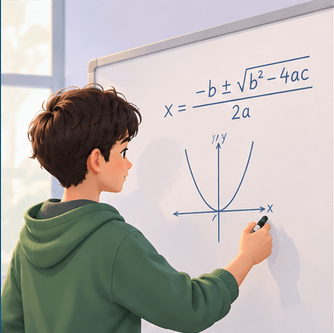
Do you remember when helping your child with math homework felt simple? Maybe some felt it was like checking the flashcard, and for some it was just helping them with basic multiplication. For parents, that easy phase ends the moment their child walks into high school. Suddenly the kitchen table becomes a place of discussion and confusion. There are symbols, graphs, functions, and equations that seem like a language. If you are someone trying to figure out the right order of math classes for your teenager, it can feel like trying to decode a foreign language. But here we have you back.

Most high schools follow a fixed path when it comes to math tracks, a very specific, progressive ladder. Here, missing a single step or rushing past a core concept can cause a student’s confidence to collapse in the following year.

This is where math stops being just about basic numbers and starts being about abstract relationships. Variables like x and y will come up; the child needs to solve linear equations and read complex graphs.
Geometry is again a chapter that moves away from intense calculation and focuses heavily on shapes, spatial reasoning, measurement formulas, and logical proofs. If your child is a visual learner who loves art or building toys, they will likely find geometry much more intuitive than algebra.
This is famously the year where math gets tough for many students. Algebra 2 returns to the concepts but makes them significantly more advanced, introducing things like logarithms, quadratic equations, and complex coordinate graphing.

Once your teenager clears Algebra 2, they reach a turning point, and one of the most common questions parents come up with is: what comes after algebra 2? The choice you make here should depend entirely on your child’s future goals and stress limits.
For students aiming for competitive university programs or STEM fields, the next step is Pre-Calculus.
For kids leaning toward humanities, business, or nursing, pivoting to Statistics is an excellent option because it focuses on real-world data tracking rather than dense theory.
When parents ask what is the highest level of math a student can achieve in high school is, the definitive answer is Calculus BC. This rigorous course is essentially the exact same material taught to second-semester engineering students in university. It requires massive dedication, high logical speed, and flawless algebra skills.

As a parent, your biggest job isn’t to force your child into the hardest class available just to look good on paper. The goal is to find the sweet spot where they are appropriately challenged but still completely mastering the concepts.
At Jainam Classes, we specialize in taking the anxiety out of high school math. Our expert tutors don’t just help kids memorize formulas for a Friday test; we look closely at their unique learning style, fix hidden conceptual gaps from previous years, and build genuine logical confidence. Let us help your child climb the math ladder at a pace that keeps them inspired and successful.
1. What math do most 11th graders take?
The vast majority of 11th graders take either Algebra 2 or Pre-Calculus. It depends entirely on whether they took Algebra 1 in middle school or waited until their freshman year of high school to start the sequence.
2. Is taking Calculus required to get into a good college?
No, calculus is not a mandatory requirement for graduation or general college admission. However, if your child is explicitly applying for competitive STEM programs like engineering, data science, or physics, colleges will expect to see calculus on their high school transcript.
3. What is the difference between Algebra 2 and Pre-Calculus?
Algebra 2 teaches your child how to solve equations and graph basic functions. Pre-Calculus takes those exact same functions and applies them to advanced trigonometry, vectors, and matrices, acting as a direct bridge to university-level engineering concepts.
4. What should I do if my child is struggling with high school math levels?
Don’t wait for the end-of-term report card to act. High school math moves incredibly fast, and if a child misses a concept in week three, they will be completely lost by week six. Address the confusion early with structured support to keep their confidence intact.
5. How can Jainam Classes help my child handle advanced high school math subjects?
We match your child with professional mentors who break down intimidating textbook theorems into simple, visual steps. Our small group settings and targeted practice modules ensure your teen gets the individual attention they need to master their school curriculum easily.