Have you noticed how some children learn effortlessly while others struggle?
Why do some kids calculate faster without counting on fingers?
It’s not talent; it’s the early brain training and brain development activities for children before the age of 10.
Research shows that children below the age of 10 have peak neuroplasticity, the time when the brain forms connections faster than at any stage of life, and 90 percent of the brain development happens within this age. So, smart parents introduce an abacus to their children before age 10 to shape the brain wires.
What happens if you wait?
Many parents do not want to burden their kids with extra activities along with academics. But here is what they don’t realize: by the time a child crosses the age of 10, the brain slows down. Learning is still possible, but it requires more effort, more repetition, and often more pressure.

While you are waiting for problems to appear, smart parents focus on developing the child’s neuroplastic phase. Instead of reacting to low marks or math fear later, they build mental strength and improve concentration in children early.
Smart parents know the difference is not intelligence, it’s the timing which make the kid intelligent.
The abacus is traditionally considered a calculation tool, but in modern day, it is a powerful brain development system designed to train children. With regular practice with the abacus, children gradually stop relying on the physical abacus and begin visualizing the beads in their minds. An abacus helps them calculate mentally by imagining the movement of beads.
Here are some of the ways in which the abacus activates multiple areas of a child’s brain:
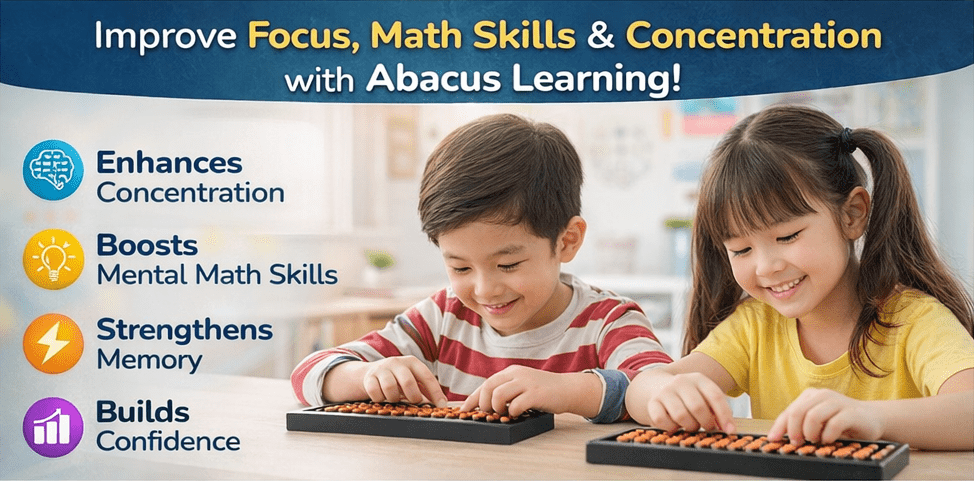
When parents introduced the abacus to their children before the age of 10, they understood the science behind brain development. And what truly convinced them that it was an abacus is the everyday changes they see in their child.
Here are some of the real-life benefits of the abacus that parents noticed:

Who does not want their child to succeed and perform better? But success comes with gradual practice and an early start while the brain is shaping itself. Now that you know the right age to start abacus is before the age of 10, do not wait. Before 10, children do not just learn faster; they wire their brains differently. Skills introduced during this phase become strengths that stay for life. Enroll your child for Jainam Abacus Classes to support their cognitive growth and experience all the advantages like smart parents.

Is an abacus good for kids?
Yes, an abacus is always good for kids; proper guidance and regular practice can be an effective brain development tool. Along with mathematical calculation, the abacus improves memory, concentration, visualization, logical thinking, and confidence.
How long is the full course of the abacus?
A full course of abacus is often for 18 to 24 months; however, the duration may also depend on the child’s age, practice consistency, learning pace, and program structure.
Which type of abacus is best?
Choosing the type of abacus is typical, as you must know how to use it in the first place before introducing it to the child. Correct guidance is equally important; however, enrolling in Jainam’s online class for the abacus can solve your confusion, as they will suggest the right tool and program suitable for your child.
Is Kumon better than an abacus?
A Kumon and an abacus are two different tools. Kumon focuses on repetitive worksheet practices, while the abacus focuses on visualization. Kumon improves speed and accuracy in math and reading, while the abacus boosts mental calculation training. Both serve different purposes, can help in your child’s mental development, and there is no comparison as they are not competitors.
How do Chinese kids calculate so fast?
Chinese kids are introduced to the abacus and trained from a very early age, which helps them visualize numbers quickly, process calculations faster, and develop a strong number sense, so they can calculate so fast.