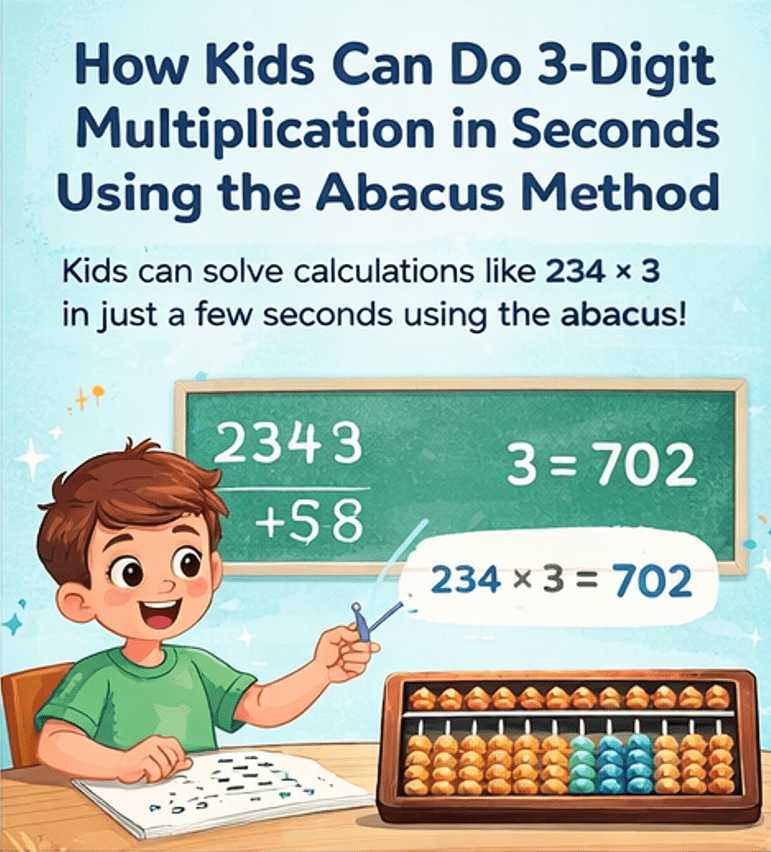
Many parents are amazed when they see children solving 3 digit multiplication in just a few seconds. What people look at as a special talent is actually the result of learning the abacus multiplication method.
Instead of writing long steps on paper, children visualize the movement of beads on an abacus and perform calculations mentally. With practice, even bigger numbers become easy to solve quickly and accurately.
The abacus method not only improves calculation speed but also helps children build strong mental math skills, concentration, and confidence in mathematics.
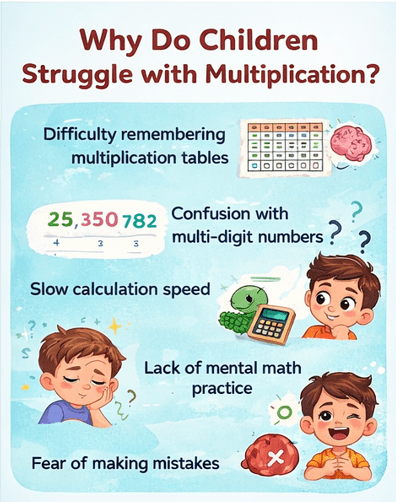
As the numbers become larger, many children start struggling with multiplication. Traditional learning methods often depend on memorization and written steps, which can slow down the calculation process.
Some common reasons children find multiplication challenging include:
Because of these challenges, many children lose confidence in the subject. This is where the abacus multiplication method offers a different and more engaging way of learning mathematics.
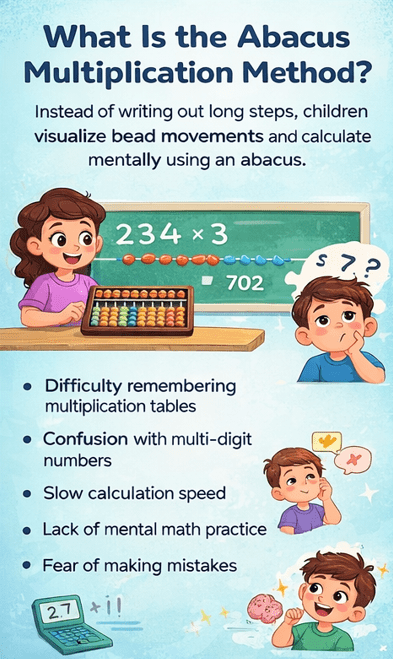
The abacus is an ancient mathematical tool that uses beads and rods to represent numbers. In modern abacus training, children first learn calculation using a physical abacus. As they practice regularly, they begin to visualize the abacus in their mind. This is known as the mental abacus technique.
Instead of relying on written calculation, children imagine bead movements and perform calculations mentally. This activates both sides of the brain and allows them to process numbers faster.
With continuous practice, students develop the ability to solve complex calculations quickly without needing paper or a calculator.
How children solve 3-digit multiplication using an abacus
In the abacus multiplication method, large numbers are broken into smaller parts. Children move beads step by step while visualizing the calculation.
For example: 234 x 3
Instead of writing the full multiplication step, the number is mentally processed as:
Children visualize the bead movements for each step and combine the values mentally. Because their brain is trained to process numbers visually, the calculation happens very quickly. With practice, students can perform 3-digit multiplication within seconds.
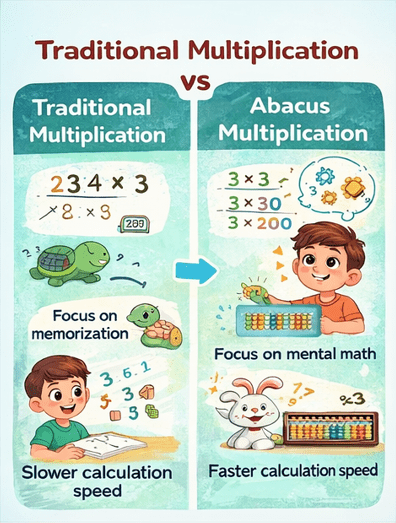
When children learn multiplication through traditional methods, they usually depend on written steps and memorization. While this approach works, it can often make calculations slower and sometimes confusing for young learners.
The abacus multiplication method, on the other hand, trains children to visualize numbers and perform calculations mentally. This makes the process faster, more engaging, and helps develop stronger brain skills.
| Traditional multiplication | Abacus multiplication |
| Require writing multiple steps | Calculations done mentally |
| Slower calculation process | Faster calculation speed |
| Focus on memorization | Focus on visualization |
| Can feel confusing for children | Interactive and engaging |
| Limited brain development | Improve brain coordination |
Learning the abacus method does much more than just improving calculation speed. It strengthens several important cognitive abilities in children.
Some key benefits include:
Because both sides of the brain are actively involved, children often show improvement in overall academic performance, not just maths.
The ability to solve 3-digit multiplication quickly is not magic; it is the result of consistent practice with the abacus multiplication method. By training children to visualize numbers and perform calculations mentally, the abacus helps develop strong mental math abilities, concentration, and confidence from an early age. At Jainam classes, our structured abacus program helps children build powerful calculation skills while making maths enjoyable and engaging.
FAQ
What are free math programs for kids?
Several free math programs for kids include platforms which offer interactive lessons, games, and practice exercises to improve math skills.
What math does a 7-year-old know?
A 7-year-old typically learns basic addition and subtraction, simple multiplication concepts, number patterns, place value, and solving basic word problems.
Which math class is best for kids?
The best math class for kids focuses on building strong fundamentals, mental maths skills, and confidence. Programs like abacus training help improve calculation speed, concentration, and problem-solving abilities.
What maths should a 7-year-old know?
By age 7, children should understand addition and subtraction within 100, basic multiplication concepts, place value, simple fractions, and solve everyday math problems.
How high should a 6-year-old count?
Most 6-year-olds can count up to 100 and start understanding number sequences, skip counting (like 2s, 5s, and 10s), and basic additions.