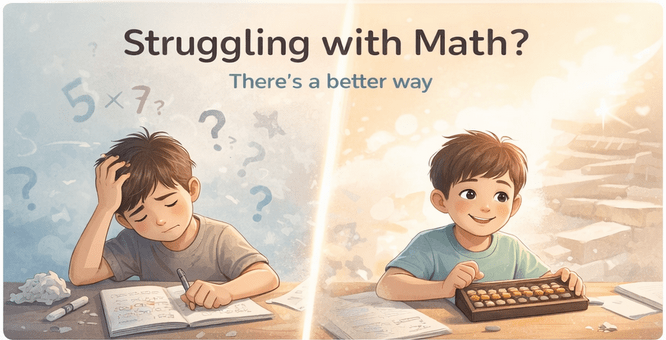
Are you worried your child struggles with math? You’re not alone. Many parents of 8- to 14-year-olds see their kids struggle with numbers and equations. The thought of “my child weak in math, what to do?” can be frustrating for both child and parent.
Many parents recognize that math is a learned skill, not an inherent talent, so they enroll their children in abacus training to build, strengthen, and even enjoy math through the right approach.
Here are some of the ways that can help you understand your child’s problem in maths and how to deal with it.

Before jumping to solutions, parents must first understand the reasons why kids are weak in maths in the first place. The reasons vary, but some of the most common ones include:
Identifying the root cause is the first step. Observe your child during homework:
Each pattern points to a different solution.

Here are some of the parent-friendly tips that you can start using today to improve math skills for kids at home:
1. Go Back to Basics
If your child is weak in math, resist the urge to push ahead. Instead, identify where the gap started. Rebuilding from a solid foundation is far more effective than drilling into grade-level problems on shaky ground.
2. Make Math Part of Daily Life
One of the best ways to improve math skills for kids at home is to bring numbers into everyday life. Ask your child to calculate the grocery bill, measure ingredients while cooking, or count change at a shop.
3. How to Make Kids Faster at Calculations
Speed in calculation comes from practice and pattern recognition, not pressure. Here is how to make kids faster at calculation without stress:
4. Use Visual and Hands-On Tools
Many children in the 8–14 age group are visual learners. Use graph paper, coloured blocks, or drawing diagrams to explain fractions, geometry, and word problems.
5. Enroll in Abacus classes
The abacus is one of the oldest and most effective tools for building number sense and mental calculation speed. Children who learn the abacus develop the ability to visualise numbers as beads, which trains the brain to calculate quickly and accurately, without relying on fingers or paper.
If your child is weak in math, what to do is important, but so is knowing what to avoid:

If you have tried to help your child struggling with math at home but nothing seems to be working, it may be time to bring in outside support. One of the most effective options is enrolling your child in online abacus classes.
These programmes are structured, engaging, and designed to improve mental calculation speed and confidence, all from the comfort of home, with no commute and flexible scheduling.
Limited seats available — enroll today
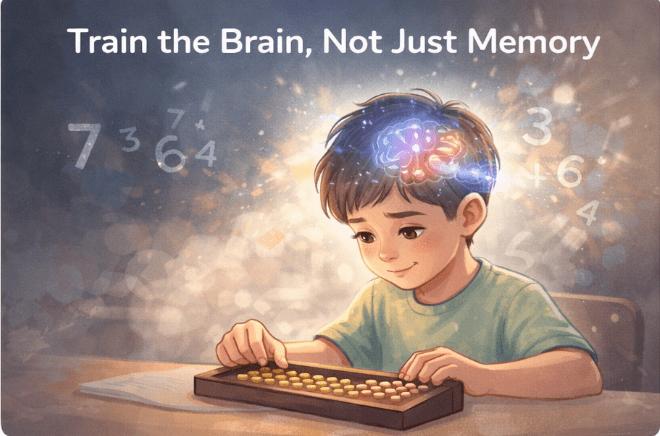
If your child is weak in math, remember, this is a challenge, not a life sentence. With patience, the right strategies to improve math skills for kids at home, and consistent support, most children can overcome their math struggles and build genuine confidence with numbers.
Your role as a parent is not to be their math teacher; it is to be their biggest supporter. And when you are ready to take that next step, Jainam Classes is here to help. Our online abacus programme is specially designed for children aged 8–14 to build calculation speed, sharpen focus, and fall in love with numbers.
Enroll today at Jainam Classes and give your child the gift of a focused, capable mind.
Q1. At what age should I start worrying if my child is weak in math?
If your child is between 8 and 14 and consistently struggling with basic calculations, word problems, or grade-level concepts, it is a good time to act.
Q2. How long does it take to improve math skills in kids?
With regular practice and the right support, most children show noticeable improvement within 2 to 3 months.
Q3. How to make kids faster in calculation at home?
Daily practice of multiplication tables, mental math tricks, number games, and abacus training are the most effective ways to build calculation speed without putting pressure on the child.
Q4. Are online abacus classes effective for children?
Yes, online abacus classes are structured, interactive, and taught by trained instructors. Children learn to calculate mentally using the abacus framework, which significantly improves both speed and accuracy over time.
Q5. Why should I choose Jainam Classes for my child?
Jainam Classes offers a specialised online abacus programme designed for children aged 8–14. With flexible scheduling, expert instructors, and measurable progress tracking, it is one of the most effective ways to help a child who is weak in math build real confidence with numbers.