Your kid just knocked over a cup of water and watched it spread across the table. To you, that’s a mess. To them, it’s a phenomenon they haven’t found words for yet. Kids are natural scientists. They poke, mix, and test everything around them. All they need is a little direction. And initially, to support them, you don’t need a lab, just a few things. These are 10 fun science experiments for kids that you can assist them in performing at home. It would hardly take 30 minutes and is completely safe.
Easy science experiments at home will keep your child engaged and learning. As kids often retain more when they experience concepts. Here are the reasons why home science activities build skills faster than school:
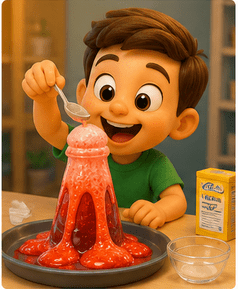
Place the bottle on a tray and add 2 tablespoons of baking soda to the bottle. Mix vinegar, a drop of dish soap, and a few drops of red food coloring in a separate cup. Pour that mixture into the bottle and step back.
The fizzing, bubbling eruption happens because vinegar (an acid) reacts with baking soda (a base) to produce carbon dioxide gas. The gas escaped quickly, pushing the soap liquid up and out.
Ask your child: “What do you think would happen if we added more baking soda?” Let them experiment.
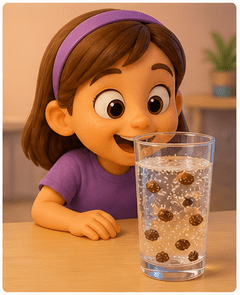
Pour soda into a clear glass and drop in a handful of raisins. Within seconds, they’ll start rising to the top, then sinking back down, almost like they’re dancing.
The carbonation in soda created tiny bubbles of carbon dioxide. Those bubbles cling to the rough surface of the rising and give them enough lift to float. When the bubbles pop at the surface, the raisins sink again, and the cycle repeats.
Ask your child: “Why do you think the raisins sink after rising?”
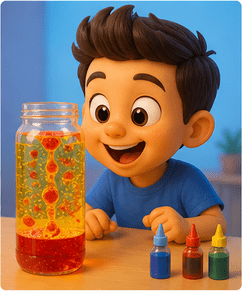
Concept: Density and liquid polarity
What you need: A clear jar or bottle, vegetable oil, water, food coloring, Alka Seltzer tablet (or salt)
Fill the jar about ¾ fill with oil, then slowly pour colored water in. Watch how they separate. Drop in a piece of Alka-Seltzer and watch colored blobs rise and fall like a real lava lamp.
Ask your child: “Can you guess which liquid is heavier just by looking?”
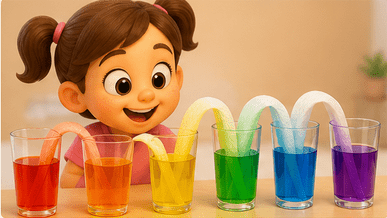
Set up 6 glasses in a row. Fill glasses 1, 3, and 5 with water, color them red, yellow, and blue. Leave glasses 2,4, and 6 empty. Connect each glass with a folded paper towel strip, ends dipping into adjacent glasses.
Over the next few hours, the colored water will slowly walk through the paper towel and into the empty glasses, mixing to create orange, green, and purple.
Ask your child: “What colors do you think mixing red and yellow will make?” Have them predict before they see it happen.
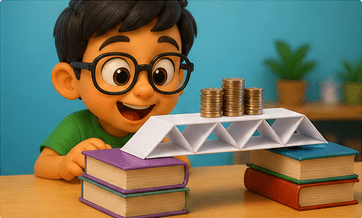
Concept: Structural engineering and load distribution
What you need: Paper, tape, coins for weight testing, and two equal stacks of books.
Set two stacks of books about 6 inches apart. Give your child 3 sheets of paper and a piece of tape. Challenge them to build a bridge that spans the gap and holds as many coins as possible.
Kids quickly figure out that a flat sheet collapses fast. But folding the paper into a fan or accordion shape or rolling it into a tube. This dramatically increases how much weight it can hold. This is the same principle engineers use when designing real bridges and buildings.
Challenge extension: Can they redesign the bridge to hold even more weight? Give them a second try.
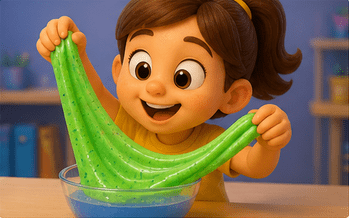
Mix ½ white school glue, ½ cup of water, food coloring and a borax solution (or contact lens solution). Knead until it comes together. Glue contains long-chain molecules called polymers. When borax is added, it creates cross-links between those chains. Squeeze it slowly, and it glows. Hit it fast, and it holds its shape.
Ask your child: “ Is slime a solid or a liquid? How do you know?”
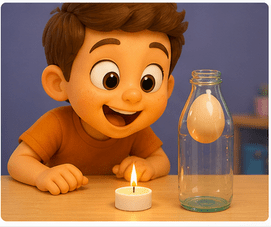
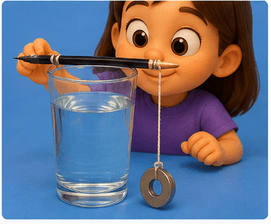
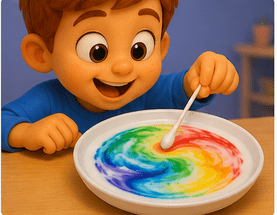
Cut butterfly shapes from tissue paper. Rub a balloon on a wool sweater, then hold it near the butterflies (without touching them) they leap up and flutter. Rubbing transfers electrons from the wool to the balloon, giving the balloon a negative charge. The lightweight tissue paper is attracted to that charge and jumps towards it.
Ask your child: “What else in the house do you think the balloon could attract?”
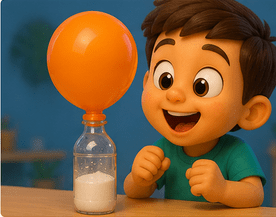
Half fill a container with water, drop in Alka-Seltzer, and snap the lid quickly. Flip it upside down and stand back. Gas pressure launches it into the air. The gas builds up inside the container until the pressure is greater than what the lid can hold. When the lid releases the gas shoots downward, and by Newton’s third lay, the container shoots upward.
Best done outdoors, it goes higher than you’d expect!
Limited seats available, enroll your child in our hands-on program.
Your child doesn’t need to be “good at science” to love it. They just need the chance to try, fail, try again, and ask, “But WHY does that happen?” That question is everything. These fun science activities for kids at home are your starting point.
Pick one experiment this weekend, enrol them with Jainam classed. See where it leads.
Yes. Every experiment here was chosen to be safe; however, adult supervision is recommended for experiments involving fire and electricity.
Q2: What supplies do I actually need?
Most of these are true, simple science experiments with household items. All the material required is mentioned with the respective experiments.
Q3: How do I keep my child focused and interested?
Kids stay far more engaged when they have a guess to prove or disprove. Moreover, let them lead the steps where safe. The moment they own the experiment, the focus follows.
Q4: Can this count as educational fun experiments for school?
Yes. Several of these experiments homeschool science curricula covering chemistry, biology, and physics basics.
Q5: My child is in Grade 1. Is this too advanced?
No, just keep the explanation simple and let the wow moment do the work.