
Every child is born with an insatiable sense of wonder. As soon as they grasp an object, they are budding scientists. They start testing the laws of physics, experimenting with cause and effect, and constantly asking, “What happens if I do this?”
As parents, you have the incredible opportunity to nurture this curiosity by turning everyday moments into hands-on learning adventures. Whether you are looking for engaging STEM activities for kids to enrich your curriculum or simply want a creative way to cure a rainy day’s boredom, introducing science experiments for kids right in your own kitchen is the perfect way to transform a typical afternoon into a laboratory of imagination.
Concept: State of matter and physical properties
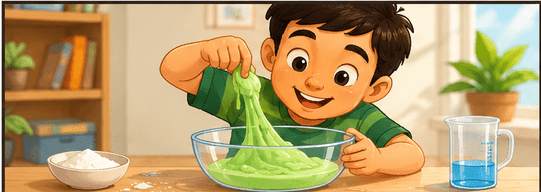
The Activity: Mix two parts cornstarch with one part water. You create a substance that acts like a solid when you punch or squeeze it, but flows like a liquid when you let it rest in your hand. It’s a fascinating way to demonstrate how some materials don’t follow standard rules of physics.
Concept: Measurement and gravity
The Activity: Make a tiny hole in the bottom of a plastic bottle. Mark equal intervals on the side of the container (using a marker) to track the water level as it drips out over time. Use a stopwatch to time how long it takes for the water to hit each mark, teaching kids how humans measured time before someone invented clocks.

Concept: Newton’s Third Law of Motion
The Activity: Attach a balloon to a straw and tape it to a small cardboard box or an empty plastic bottle fitted with bottle-cap wheels. Blow up the balloon, pinch the end, and place the car on a flat surface. When you let go, the air rushing out of the balloon provides the “action” that pushes the car forward (the “reaction”)
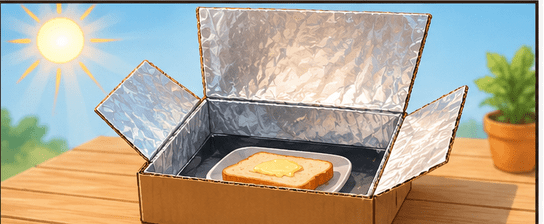
Concept: Thermodynamics and heat absorption
The Activity: Line the inside of a pizza box with aluminum foil and create a flap on the lid that can be propped open to reflect sunlight. Place a piece of bread with a slice of cheese inside, close the box, and leave it in direct sunlight. The foil traps the heat, gradually warming the food and melting the cheese.
Concept: Chemical oxidant
The Activity: Squeeze lemon juice into a bowl and use a cotton swab to write a secret message on white paper. Leave the juice to dry, and the message becomes invisible. To reveal the message, hold the paper near a lightbulb or use a warm iron (with adult supervision) to gently heat the paper. The lemon juice oxidizes and turns brown, revealing the hidden text.
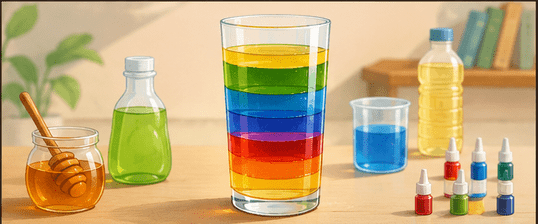
Concept: Liquid density and viscosity.
The Activity: In a tall, clear glass or vase, carefully pour layers of liquids with different densities in this order: honey, dish soap, water (dyed with food coloring), and vegetable oil. Because the liquids have different masses per unit of volume, they will stack on top of each other rather than mixing, creating a beautiful, multi colored tower.
Concept: Supersaturation and crystallization.
The Activity: Dissolve as much sugar as you can in boiling water to create a supersaturated solution. Pour the mixture into a clean jar and hang a string or a skewer inside. Over the next few days, as the water evaporates and the solution cools, sugar crystals will grow on the string, forming sparkling “rock candy” structures.
You can check out more 10 Fun Science Experiments Kids Can Do at Home (Safe & Easy)
The best part about these science experiments at home is that they require very little in terms of the budget but offer infinite returns in terms of knowledge. When you encourage your children to experiment, you are not just teaching them facts; you are teaching them to observe, to question, and to interact with the world around them. Pick one experiment this weekend, dive in, and don’t worry about the mess; the mess is just proof that learning is happening. Ready to take your child’s curiosity further? Join our programs at Jainam Online Classes and explore expert-led learning that makes STEM fun and accessible.
Science experiments foster critical thinking, patience, and problem-solving skills. By engaging in hands-on learning, children move beyond memorizing facts and begin to understand how the world works by testing hypotheses, observing reactions, and learning from trial and error.
Most of these experiments are ideal for elementary-aged children (ages 6–12). They can be easily adapted; younger children will enjoy the visual “wow” factor, while older students can delve deeper into the scientific concepts, documentation, and the “why” behind the results.
Yes, these experiments are designed to use everyday household items. However, adult supervision is always recommended, especially for activities that involve heat, small parts, or kitchen tools. Always review the activity instructions first to ensure a safe and fun environment.
While home experiments are an excellent introduction, structured learning helps turn “fun activity” into deep skill development. Jainam Online Classes offers expert-led, interactive STEM programs designed to nurture that curiosity into academic confidence and advanced scientific understanding.
No, many effective STEM activities utilize common supplies you likely already have, such as cornstarch, water, paper, and dish soap. Your kitchen is the perfect “lab” to start sparking a lifelong love for science.