Why do some children take so long to calculate simple sums?
Is this something you and all your friends worried about? Mental math speed is becoming a real concern for many parents today. You may have noticed your child using fingers, drawing strokes, or taking too much time to solve two-digit problems, and feeling nervous during calculation. This is because of either of the reasons: they are not confident enough or feel pressure and stress instead of enjoying the subject.
In today’s competitive world, speed and accuracy both matters and so, smart parents are training their kids with an abacus to improve calculation speed and logical thinking. Abacus, being an ancient technic can be questioned with “Does Abacus Really Improve Mental Math?”
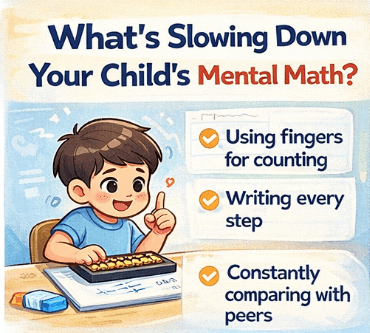
Before we understand whether the abacus improves mental maths, it is important to understand the reason behind your child’s struggle. Here are some common factors that affect a child’s mental calculation ability:
Normally, parents start the basic addition and subtraction training using fingers. While this method works initially, it slows down thinking speed and becomes a habit that limits mental growth.
The traditional teaching method focused heavily on writing every step and memorizing. Although it helps in concept clarity, it often prevents children from developing fast mental processing skills.
When children are constantly judged and compared with others for being slow, anxiety blocks their thinking speed. Sometimes they know the answer, but pressure reduces their performance.
Mental maths requires concentration, with high screen time and other social distractions today, children are struggling to maintain the attention needed for faster calculations.
Mental maths requires the ability to “see” numbers in the mind. Children who can not visualize numbers are unable to hold numbers in the brain while performing calculations. It’s not their fault; they just need proper training for fast calculation methods for students.
One of the best mental math techniques for kids today is primarily the abacus. It teaches children to calculate faster and change the way their brain processes number. Unlike academic learning, it does not depend on writing steps; abacus training begins with physical beads, which represent numbers that are moved to perform addition, subtraction, multiplication, and division.
Being a physical tool, it brings a real shift in improving children’s mental maths. With regular practice, gradually the physical beads disappear. Children start visualizing the abacus in their minds and move imaginary beads mentally. Instead of thinking step-by-step 8 + 9… carry 1.. Add again. Here is what an abacus does:
Here is the difference experienced by the kids who took abacus classes and ones without abacus classes:
| Comparison Areas | Without Abacus Classes | With Abacus Classes |
| Calculation method | Writing process | Visual mental processing |
| Dependency | Fingers, strokes, rough works | Metal visualization of beads |
| Speed | 30-60 sec per sum | 5-10 sec per sum |
| Accuracy level | Chances of small mistakes | Very low chances or mistake |
| Confidence | Low, hesitant, nervous | Calm and confident |
| Working memory use | Limited retention of numbers | Strong number holding power |
The above comparison clearly shows that a child can solve 25 – 30 calculations in an exam when he can save 5-10 sec per sum and use the extra time for reviewing the answer and staying relaxed instead of rushing.
The abacus really improves mental maths. When children learn to visualize numbers, over time, they forget the finger counting and rough work methods, which eventually improves working memory and builds real confidence. The abacus class benefit is not just speed, but a life-changing program. If you want your child to develop strong calculation skills along with confidence and logical thinking, structured abacus training can make a visual difference. At Jainam abacus classes you child don’t just calculate faster, they think smarter.
What is the abacus rule?
The basic rule of the abacus is that each bead represents a specific value based on its position. The lower beads represent 1 unit each, and the upper bead represents 5 units also; each rod stands for place value.
What is an abacus called now?
An abacus is still known as an abacus; however, modern trainers often call it a mental abacus, soroban, or abacus brain development tool.
What is level 1 in an abacus?
Level 1 is the foundation stage of the abacus, where number representation, understanding place values, practicing basic addition and subtraction, and developing correct finger movement techniques are introduced to the children.
What is the cost of an abacus?
The cost of the physical abacus tool is affordable depending on the quality; however, the training program differs in fees based on duration, levels, and certification structure.
What is the correct age to learn the abacus?
The best age to learn the abacus is below 10; however, one can enrol their child for abacus training between the ages of 5 and 12 years.