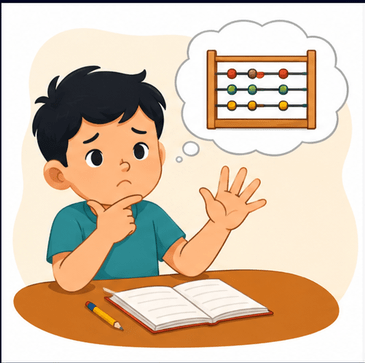
Is your child struggling with basic math homework or losing focus during study time? You are not alone, many parents are frustrated with this problem. Many children find traditional, text-heavy numerical calculation difficult and boring. They feel less confident and more anxious. If you are wondering how to know if your child needs abacus classes, the answer lies in observing how they interact with numbers daily.
Enrolling your child in specialized abacus classes help them learn maths easily through physical, visual games. So, by just identifying a few early warning signs, you can understand if they need an abacus class or not.
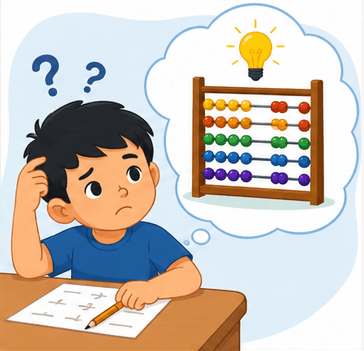
Once you get the idea of what’s bothering your child’s brain development, you can introduce your child to abacus math classes at the perfect time to maximize their cognitive growth and lifelong analytical skills.
Children above 6 or 7 years must be ahead of using fingers, if they are still using their fingers to solve simple addition or subtraction, it means they are relying on physical aids rather than visualizing numbers.
Enrolling them in online abacus classes helps them move away from finger counting by training them to manipulate visual beads mentally, which dramatically increases their calculation speed.

If your child avoids and makes excuses while doing math homework, or even cries during the subject math, they are experiencing math anxiety. Traditional abstract math can feel intimidating. Abacus classes turn calculation into a hands-on, fun game, replacing fear with a sense of fun and early academic achievement.
Slow at solving basic equations and frequently making careless mistakes on simple math homework, are often signs of poor concentration. Abacus class for brain development program fixes this by sharpening focus, improving memory retention, and training the brain to calculate accurately within seconds.
Distracted every 5 minutes during study sessions? Your child lacks cognitive endurance. Learning to play with abacus beads requires intense, unbroken concentration for short bursts. Over time, this discipline’s training expands your child’s general attention span, helping them focus better across all school subjects.
Word problems, lack of spatial awareness, or difficulty in hard to follow multi-step instructions, these require logical processing, your child needs a boost. Math is not just about memorizing, it’s about logical reasoning. Mental math training develops both the left and right hemispheres of the brain, improving overall analytical skill.
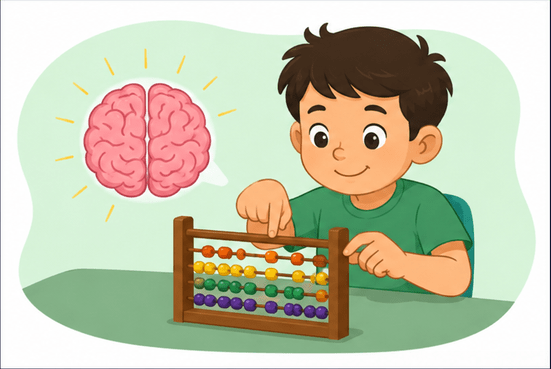
An abacus is an oldest calculating tool made of a wooden or plastic frame with beads sliding on rods. While it looks like a simple toy, it is actually a highly sophisticated tool for modern brain development. We also have digital abacus these days. In online abacus classes for beginners, children are taught to move these beads with specific finger movements to perform addition, subtraction, multiplication, and division.
As your child practices, they gradually stop using the physical instrument entirely. Instead, they learn to visualize the abacus in their mind, moving the imaginary beads mentally to solve complex numbers at lightning speed. This practice bridges the gap between abstract numbers and physical reality, acting as a complete workout for both the left and right hemispheres of your child’s brain.
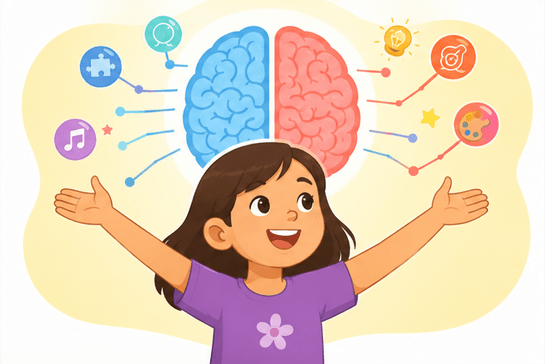
Your aim should be your child’s overall growth and not just grades in the reportcard. So, working on a subject like math is about building logic, focus, and problem-solving skills that your child will use for the rest of their life. As a parent, giving your child the right tools early means they can face school exams and future challenges without stress or fear. At Jainam classes, we make sure learning never feels like a boring chore.
Book a FREE DEMO CLASS and see how quickly your child can build real confidence.
No, the abacus method focuses heavily on mental visualization and speed, while school math focuses on step-by-step written calculations. Instead of confusing, it will help build the base and confidence.
The best age window to enroll a child is between 5 and 12 years old. During this stage, the brain’s neuroplasticity is at its peak, making it incredibly easy for young children to master the visualizations needed for faster calculation.
It all depends on the child’s seriousness and consistency. Maths can not be memorised; on average, a child may take a few months with just 30 to 60 minutes of online sessions for improvement.
4. How much daily practice is required at home for the best results?
Daily 10 to 15 minutes minimum with a deep focus daily practice can show your child’s behaviour shift towards math. However, daily 45 to 60 minutes can show rapid improvement.
5. What is good for beginners online or offline abacus classs?