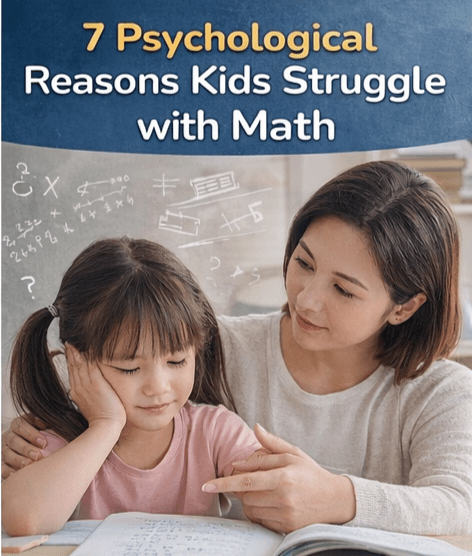
Even your child is afraid of maths!
Your child hating maths is not a subject problem; it’s their brain and confidence that dislikes it.
6 out of 10 children are facing this issue. But what if they don’t hate maths, they just don’t like the feeling when solving maths. This feeling turns the homework time into arguments, simple calculations into battle, and they seem exhausted when the numbers appear. You may be wondering – Is my child not intelligent enough? Or are they just careless? Well, math struggle is more often because of a lack of confidence and guidance.
Here are signs your child hates maths:
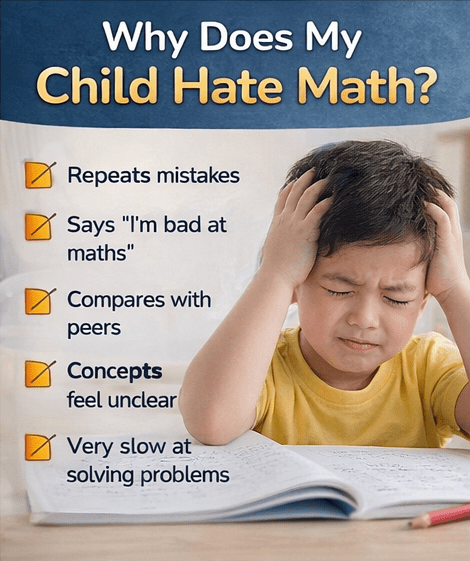
Before blaming your child for poor maths, you must try to identify the problem and reframe it. When your child repeatedly struggles with answers, feels slower than classmates, gets corrected often, or senses pressure around marks, the brain begins to associate math with stress. Over time, this math anxiety in children becomes a negative learning association.
So, as soon as you observe the above-mentioned signs, start asking yourself:
When you change the lenses, the goal also changes, and instead of blaming them, you start improving alongside.
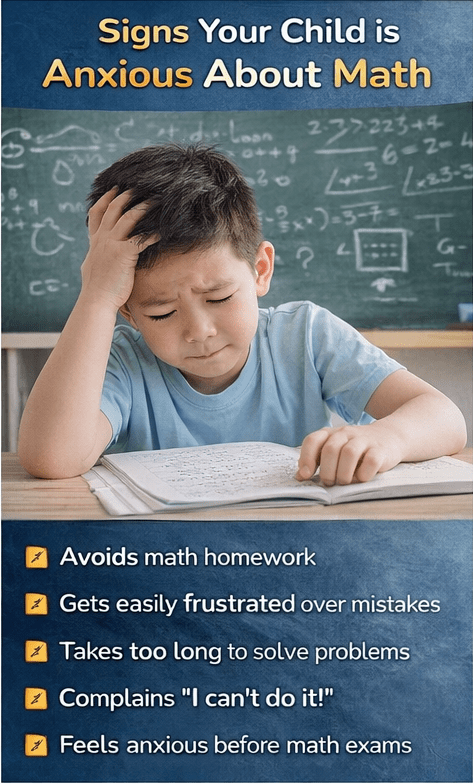
When a child keeps making mistakes despite trying, it slowly affects their self-belief. Each wrong answer feels like proof that they can’t do maths, and slowly they start seeing this as personal failure.
Children are extremely sensitive to comparison, whether it is at home or in school. Even if the intention is to motivate, this comparison often creates pressure and self-doubt.
Maths is like a staircase; each step depends on the previous one. If the basic concepts are unclear, future topics become confusing. A child may not openly understand, but the frustration begins here.
Constant reminders about marks, performance, and expectation can create anxiety. This may affect concentration, logical thinking, and may freeze their ability to solve even simple problems.
Every child’s brain processes information differently; for some, it’s easy, for some, it’s difficult, and they may take longer. Today, in the fast-paced world, this can make them feel left behind and less intelligent.
Every mentor or teacher has their own approach to teaching; a harsh correction and repeated public criticism can impact a child’s relationship with the subject. This can also drain the kid emotionally, creating a mental block.
Math has defined rules and methods that may be difficult for some children to adapt to. However, a proper guide and introduction of different approaches to solve the problem can make it easy improve a child’s confidence in studies.
When your child is struggling with maths, here are the dos and don’ts for how to make maths fun for kids.
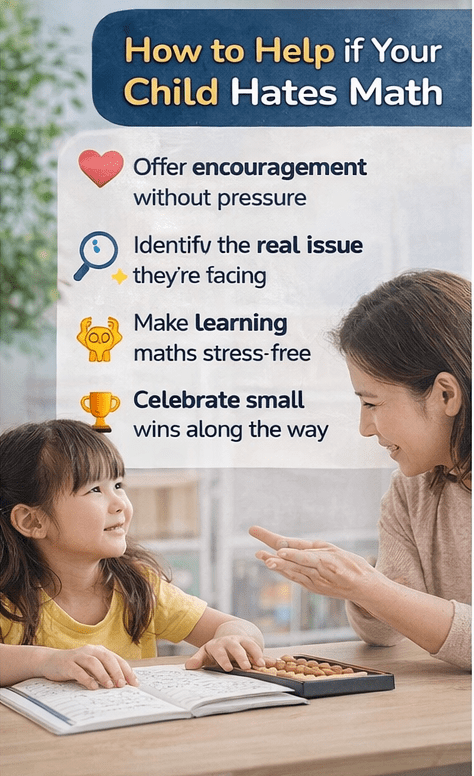
When your child starts hating maths, it’s your turn to think. Maths is not limited to being just a subject; it has an overall impact on the child’s confidence, clarity, and how they emotionally experience problems.
Instead of stressing over or ignoring the issue, enroll your child in the right support and structured guidance to improve. This may not help overnight, but small success begins to happen consistently, and resistance slowly turns into willingness. As the child feels capable, their marks and performance will reflect their success.
Which math class is best for kids?
Online programs at Jainam for children are the best. Depending on their age, learning style, and specific struggle, they are guided, get foundational clarity, and also help with speed, focus, and number confidence is taken care of.
What is a free math program for kids?
There are many free online platforms that offer basic maths practices, and YouTube has different channels with free programs. However, children benefit more from structured guidance and interactive training.
How high should a 6-year-old count?
A child at the age of 6 must be able to comfortably count up to 100 and understand basic number concepts. They must also be able to perform forward and backward counting, do simple addition and subtraction within 20, and understand place value basics (tens and ones).
Is Kumon or Mathnasium better?
Yes, both Kumon and Mathnasium are well-structured programs with different benefits. Kumon focuses on repetition and independent practice to build speed and discipline, while Mathnasium emphasizes conceptual understanding with guided instruction.
What is the best math learning program for children?
This question cannot have a definite answer, as every kid has different areas to be improved and different programs have different focuses. For the early birds, brain-based programs help in developing visualization, focus, and calculation.