Your child spends 2-3 hours or even more on screen daily. Is it true?
If yes, it’s time to wake up, and along with reducing the screen time for kids, it is crucial to introduce them with something that rewires their brain. Today, cartoons, reels, games, YouTube, and online classes have quietly become a major part of childhood. However, the screens are not evil, but too much passive consumption slowly changes how their brains respond.
What if you could use the technology for productive activities for kids after school? What if just 30 minutes of their day can be replaced with abacus classes? Yes, you have to replace screen time with brain time.
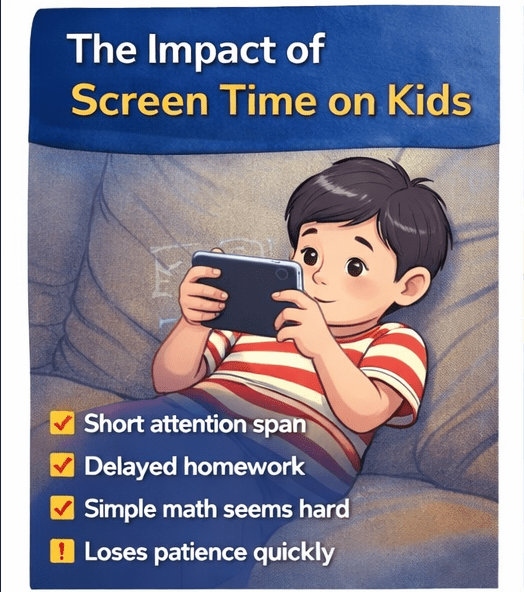
The screen can not be avoided; it’s now necessary from online learning to entertainment, but when the child spends hours passively watching fast-moving visuals, their brain adapts to:
And once they are addicted to screens, this affects their natural learning rhythm, and you may notice the following changes in their behaviour:
There are the silent impacts of excessive screen time, and when you start seeing the signs, it’s important to balance the situation with smart practices.
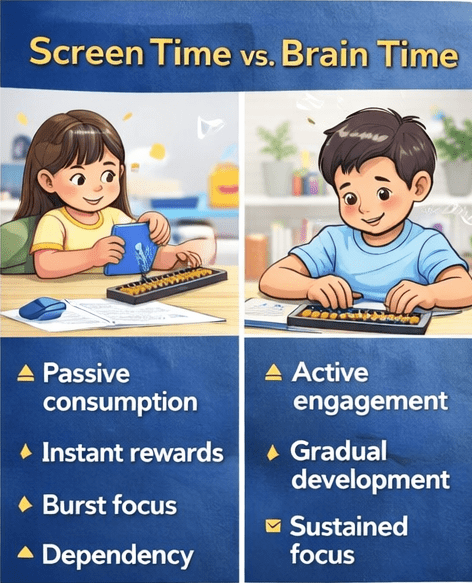
When a child scrolls, watches, or plays for long periods, the brain gets trained for speed, instant results, and constant stimulation. And here is when you must ask yourself, “Are they consuming or are they developing. Here is the difference between screen time and brain time
| Screen Time | Brain Time |
| Passive consumption | Active mental engagement |
| Instant rewards | Gradual skill development |
| Short burst of focus | Sustained concentration |
| Quick entertainment | Deep thinking |
| Dependency on devices | Independence in problem-solving |
Although both are forms of training, the outcomes are very different. If you look closely, screen time entertains the mind, whereas brain time strengthens it.
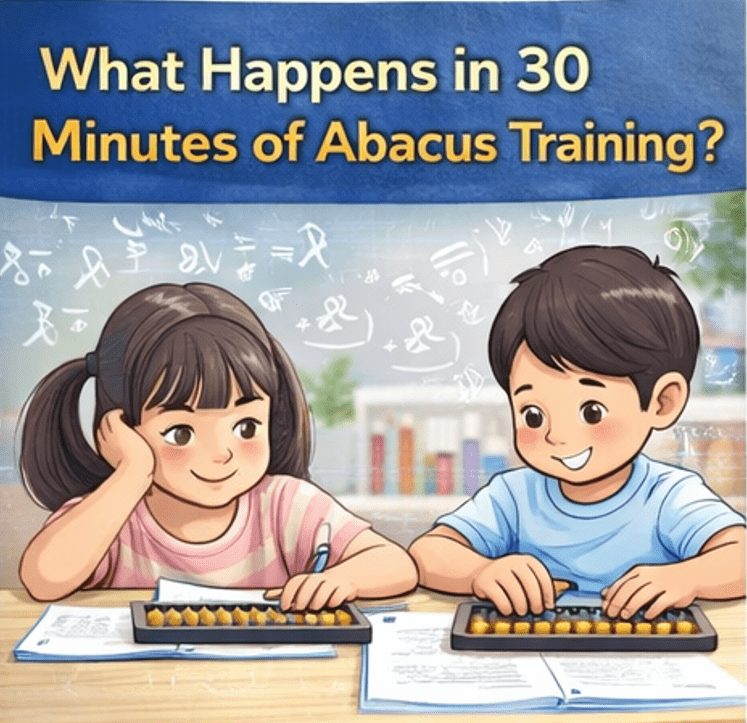
An abacus is one of the best focus improvement activities for kids. Everyday 30 minutes spent in a structured, focused, and consistent program, their brain begins to reshape how a child thinks. The abacus is beyond calculation; its daily training here is as follows:
The abacus required children to visualize beads while solving numbers mentally. The left brain handles logic and calculations, and the right brain handles imagination and visualization. When both sides work together regularly, neural connections strengthen. Thinking becomes faster and clearer.
Children stop depending on their fingers. They stop fearing large numbers or reaching for calculators. Instead, they calculate quickly and accurately in their minds. When math fear reduces, overall academic confidence increases.
During abacus practice, children listen carefully, process numbers quickly, remember sequences, and respond accurately. There is no scrolling, no switching tabs, no distractions.
Abacus trains children to visualize numbers mentally, which strengthens working memory and recall ability. Children complete homework faster, have better number retention, and improved classroom participation.
Unlike screens that provide immediate results, the abacus teaches delayed achievement. Children learn to practice, which leads to progress; effort leads to improvement, and focus leads to results.
Conclusion
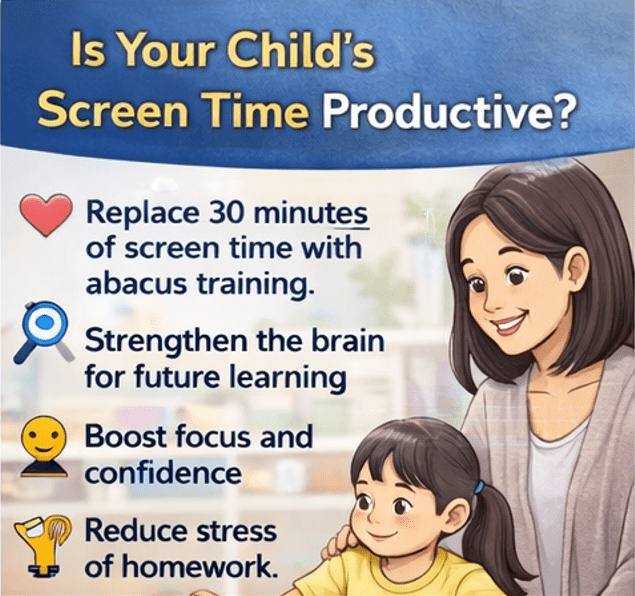
30 minutes may seem small, but when you reduce screen time after school brain activities for kids with abacus training it becomes a mental workout session. Though screens will always be part of your child’s life, you cannot remove them, but reframe them. Enroll your child for Jainam Abacus classes to reduce their passive screen time, boost their focus, and increase patience. With just 30 minutes of abacus class a day dedicated to structured brain training, the child builds confidence, increases concentration, and mental growth. Just replace 30 minutes of screen time with 30 minutes of brain time.
FAQ
What is better than an abacus?
No, the abacus is the best option. If you aim to improve your child’s concentration, mental calculation speed, memory, and overall development, an abacus is the most effective option.
Is it worth learning the abacus?
Yes, the abacus is worth learning. The best age to start is before 10 years.
How to write 1 to 100 in abacus?
Abacu has beads on rods that represent numbers. Each rod represents a place value (one, tens, hundreds). Beads are moved towards the beam to represent numbers.
For example:
1 to 9 numbers are shown on ones rod.
10 to 99 uses both the ones and tens rods.
100 activates the hundreds rod.
What are the disadvantages of abacus math?
When comparing the benefits of the abacus, it has very few disadvantages; it requires regular practice, results are not instant, and proper guidance is crucial.
Is an abacus good for the brain?
Yes, an abacus is very good for the brain. It enhances logical thinking, visualization skills, processing speed, concentration, and working memory. An abacus is considered not just a math tool but is a brain development program.