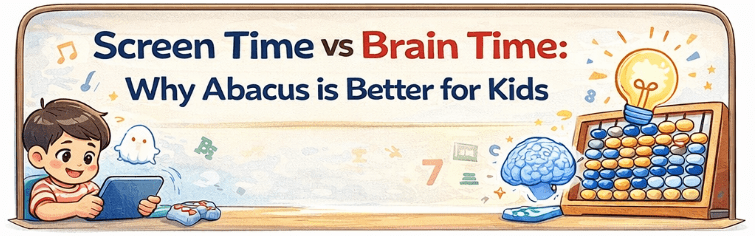
Every child as young as two is seen, eyes locked on a glowing screen, thumb moving on autopilot. Children between the ages of 8 and 12 now spend an average of 2 to 4 hours per day on screens outside of schoolwork. That’s more waking hours than most kids spend playing, reading, or simply being bored; it is when a lot of real brain-building happens.
Screens aren’t inherently evil, but the mental engagement on screens is categorically different from the kind that builds a developing brain.
Enrolling them in abacus training is now one of the most effective forms of brain-building engagement for kids.
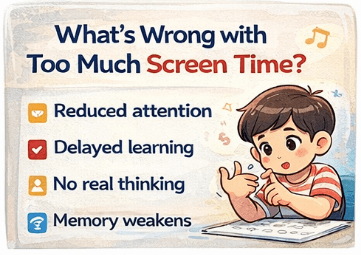
Most parents worry about screen time because of content, inappropriate videos, violent games, and social media. Those are real concerns, but neuroscientists and child development experts are raising a deeper alarm. It’s not just what kids watch, it’s what their brains are doing while they watch it.
The core issue is something researchers call passive consumption. When a child watches a video or taps through a game designed by behavioral psychologists, their brain is receiving stimulation, but it is not being asked to produce anything.
No prediction.
No problem-solving.
No memory consolidation.
The prefrontal cortex, i.e., the brain’s executive function command center, responsible for planning, focus, and impulse control largely sits idle.
Children with higher screen time at age 2 had lower developmental scores at ages 3 and 5. The damage wasn’t from harmful content; it was from cognitive underuse during a critical developmental window.
Think of it this way: a muscle that isn’t used doesn’t strengthen. The same principle applies to neural pathways. And the years between 4 and 12 are precisely when those pathways for math, language, focus, and creativity are most “plastic”, most ready to be wired strong or left thin.
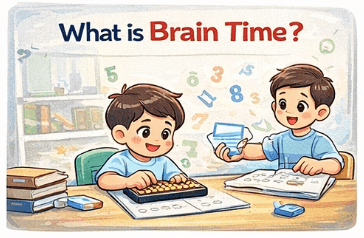
“Brain time” describes activities that require your child’s mind to actively work, to hold information, transform it, and produce an output.
Brain time is any activity that makes your child’s mind actually work, solving, creating, remembering, and figuring things out. Unlike passive screen time, where content is simply consumed, brain time demands effort. And that effort is exactly what builds a stronger, sharper, more focused brain.
The good news is that brain time doesn’t have to be boring or forced. Reading together, solving puzzles, cooking with numbers, playing an instrument, or practising the abacus all count. What matters is that the brain is being asked to produce something, not just receive it. That small but crucial difference, repeated daily, is what separates a childhood that builds real cognitive strength from one that simply passes the time.
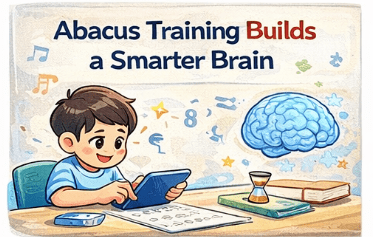
The abacus has been used across Asia — particularly in China, Japan, and India — for centuries. But over the past three decades, neuroscientists have studied what happens inside children’s brains during abacus training, and the results are remarkable.
It builds a “mental abacus” in the visuospatial cortex. Advanced abacus learners develop what researchers call a mental abacus, an internalized image of the abacus that they can manipulate in their mind’s eye to perform calculations at astonishing speed, without any physical tool.
Brain MRI scans show these children using their visuospatial cortex (a region usually associated with navigation and spatial reasoning) for arithmetic and mental math. This cross-activation of brain regions means abacus training literally rewires the math circuitry in a child’s brain.
It dramatically improves working memory. Working memory is your brain’s scratch pad, the space where you hold and manipulate information in real time. It’s strongly correlated with academic performance across every subject, including reading comprehension.
It trains voluntary, top-down attention. Here’s the key distinction: screens train involuntary attention, and your child’s eyes snap to a flashing notification. Abacus training develops voluntary attention, the harder, more valuable ability to choose what to focus on and sustain it. This is exactly the capacity that gets eroded by heavy screen use, and exactly what children need for academic and lifelong success.
Abacus also increases grey matter density in the prefrontal cortex, improves in both sequential and simultaneous information processing, develops bilateral hand-brain coordination, stronger number sense and mathematical intuition, and better self-regulation and patience through structured practice.
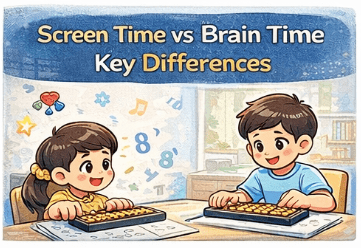
Here are some of the common differences that make abacus training one of the best activities for brain time.
| Factor | Screen Time | Abacus Training |
| Attention Span | Shortens over time | Builds and strengthens |
| Working Memory | Weakens with passive use | Significantly improves |
| Focus Type | Involuntary (grabbed by content) | Voluntary (Self-directed) |
| Math Ability | Minimal direct benefit | Strong number sense and speed |
| Fine Motor Skills | Minimal (tap and swipe) | Strong (precise bead movement) |
| Brain Region Used | Primarily visual vortex | Prefrontal, partial, motor cortex |
| Self-regulation | Weakens (rewards impulse) | Strengthens (reward patience) |
| Spatial Reasoning | Low activation | High activation |
| Academic Impact | Negative correlated | Positively correlated |
| Reward System | External (likes, wins, notifications) | Internal (mastery and progress) |
| Long-term cognitive effect | Diminishing returns | Compounds over time |
Limited seats available — enroll today
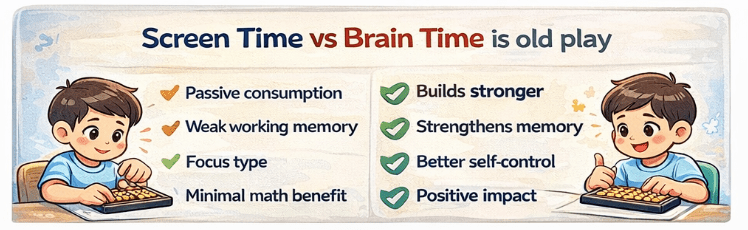
The early 4 to 14 years of childhood are the most powerful window for brain development your child will ever have. Filling that window with passive screen time is a cost that shows up slowly in shortened attention spans, weaker focus, and a fragile relationship with learning.
Abacus training is one of the simplest, most effective ways to change that. Twenty focused minutes a day is all it takes to start building a sharper, stronger, more confident mind.
Our abacus programme is designed for children aged 4 to 14 — structured, engaging, and proven to deliver real results. Hundreds of families have already made the switch from screen time to brain time.
Enroll today at Jainam Classes and give your child the gift of a focused, capable mind.
FAQ
1. At what age should my child start abacus training?
Your child’s age anywhere between 4 and 6 is the sweet spot. The brain is most receptive at this age, but children up to 14 benefit too. Earlier just means more time for the gains to build.
2. How is abacus training different from math taught in school?
School math teaches your child how to solve problems. Abacus training builds the brain that solves the problem, builds stronger memory, sharper focus, and a natural feel for numbers that makes everything else easier.
3. How much time does a child need to practise daily?
Twenty to thirty minutes a day is enough. Consistency is what matters. A child who shows up daily for twenty minutes will always outperform one who does a long session once a week.
4. Will abacus training reduce my child’s screen time naturally?
Yes! Once children start moving up levels and beating their own scores, they get genuinely hooked. Many parents notice the shift without even trying.
5. Is abacus still relevant when calculators exist?
Calculators do the math. They cannot build focus, memory, or the ability to think clearly under pressure. That is exactly what abacus training does and those skills matter in every classroom and career.