Your child being glued to the screen now was before just an option to keep them busy for a few minutes. But now it has become their habit, and you’re wondering if you’ve made a mistake.
Nearly every parent today is navigating the exact same tension. However, smart parents do the real talk about how much screen time for kids is good and how to navigate the impact. If you are someone think the same, let’s break it all down.
There’s a big difference between your child watching a math tutorial and mindlessly scrolling through YouTube shorts. The type of content, the age of the child, and how long they’re watching all matter enormously.
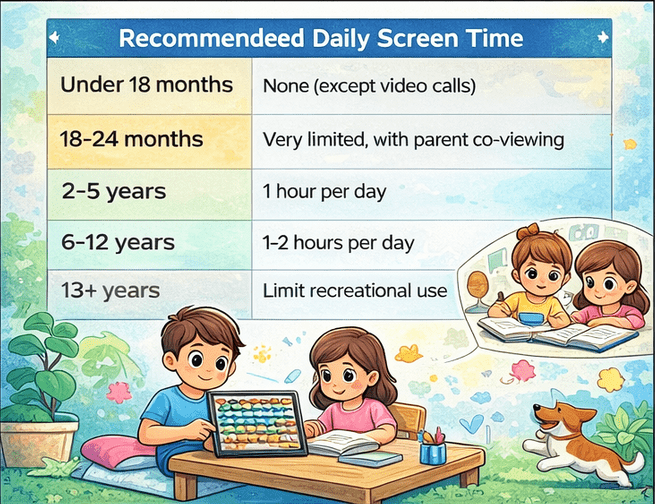
| Age Group | Recommended Daily Screen Time | Notes |
| Under 18 months | None (except video calls) | Critical brain development stage |
| 18–24 months | Very limited, with parent co-viewing | High-quality content only |
| 2–5 years | 1 hour per day | Educational content preferred |
| 6–12 years | 1–2 hours per day (non-educational) | Balance with outdoor play and reading |
| 13+ years | Limit recreational use | Prioritize sleep and real-world interaction |
These guidelines are meant to protect children during important periods of brain development, not to make parenting harder.
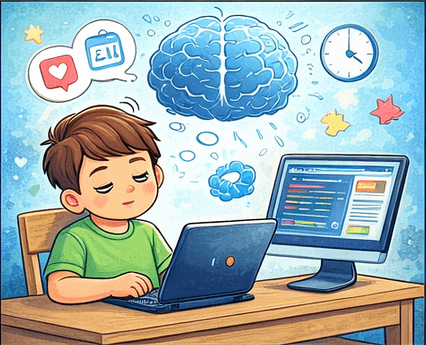
Excessive screen time impacts your child’s brain functioning, along with time management. Here are some of the negative effects of screen time children:
Children who spent more than seven hours a day in front of screens showed premature thinning of the frontal cortex, the part of the brain responsible for critical thinking, reasoning, and decision-making. This thinning is typically seen much later in development.
Screens before bed, even “just 30 minutes,” mess with melatonin production and delay sleep onset. Poor sleep doesn’t just make kids tired. It directly impairs memory consolidation, emotional regulation, and the ability to focus the next day.
Fast-paced, visually stimulating content trains the brain to expect constant novelty. When kids switch to slower activities like learning, reading, writing, or listening in class, these tasks feel dull by comparison. This is directly related to concentration problems and, in some cases, a higher risk of ADHD symptoms.
Children between the ages of 3 and 5 who spent more than two hours per day on screens were significantly more likely to show ADHD-related behaviours than those who spent less.
Very young children learn language through real, back-and-forth conversation, not by watching a screen. A tablet telling a story spoon-feeds images and words all at once, but it doesn’t respond to your child or build the neural pathways that live human interaction does.
Children who spent more than two hours a day on screens scored lower on cognitive and language tests. The effect was consistent across age groups.
And it’s worth noting that kids who read from books retained information better than those who read the same content on a screen.
Want your child to develop sharper focus and stronger mental skills without a screen? Join our abacus program at Jainam Online Classes and see the difference.
Related Read: Why Abacus Builds Focus in Children. A great way to understand how hands-on learning develops the brain.
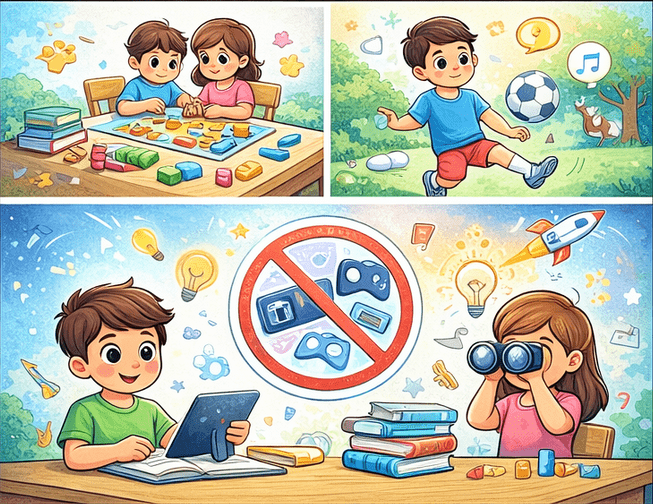
The key to reducing screen time isn’t just taking the device away — it’s replacing it with something compelling enough that your child actually wants to engage.
Here are some options that genuinely work:
Explore More: How Abacus Brain Development Works — and why it’s one of the best mental math tools for children today.
Screens are not the enemy. But they’re also not babysitters, tutors, or replacements for real-world learning and connection.
The goal isn’t a screen-free childhood that’s neither realistic nor necessary. The goal is a childhood where screens don’t crowd out the things that matter most: physical play, genuine learning, creative thinking, and the kind of focused attention that prepares your child for a lifetime of success. Enrol your child to Jainam classes and give them the best skills for life.