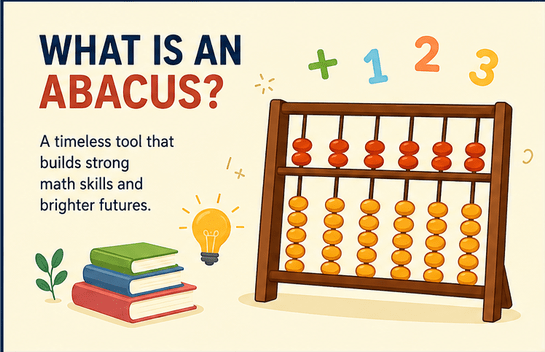
An abacus is a manual calculating tool with beads that slide on horizontal rods inside a frame. Invented thousands of years ago as one of the earliest counting devices, it has evolved from a historical calculating tool into a powerful brain development tool for children. Today it serves as a proven system to boost confidence while simultaneously unlocking a child’s mental math potential. If you are planning to enroll your child in abacus classes, you are at the right place.
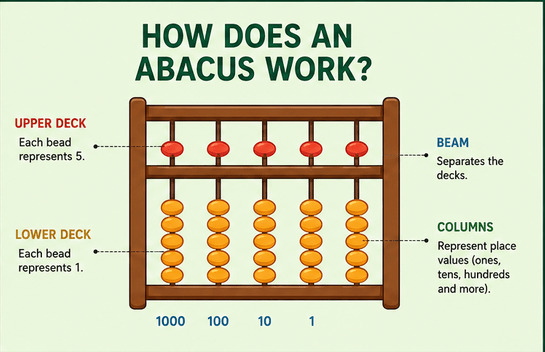
An abacus works by representing numbers through the physical positioning of beads on a structural grid, where each vertical column signifies a distinct decimal place value.
The standard modern abacus used in math programs is the Japanese Soroban. It features a rectangular wooden or plastic frame divided into two decks by a horizontal bar called the beam
The columns : Each vertical rod represents a specific place value, moving from units on the right to tens, hundreds, and thousands on the left.
The upper deck: Each rod contains one bead in the top deck, which holds a value of five.
The lower deck: Each rod holds four beads in the bottom deck, each carrying a value of one.
To use the abacus, children have to use their thumb and index finger to move beads toward or away from the center beam. By learning how an abacus works, children visually map out numbers, changing abstract math concepts into concrete physical objects they can manipulate.
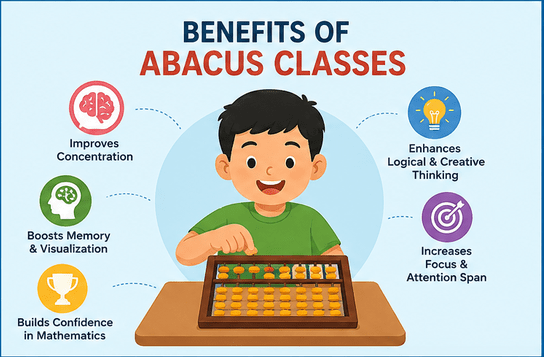
Children in the early days of their childhood can benefit the most from abacus. Studies show children who have started abacus training by the age of 5 have got immense cognitive reward.
Children can fight their math anxiety comfortably when they are trained with abacus usage, which turns the stressful subject into an engaging game.
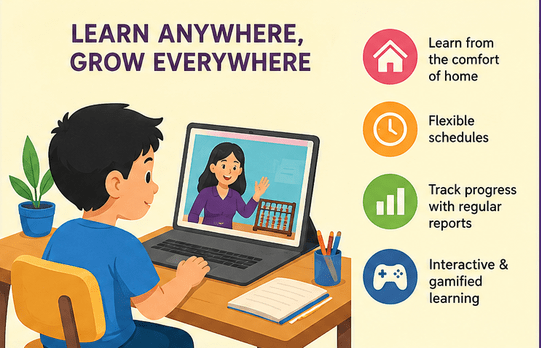
You should choose online abacus class formats because they combine professional multilevel math frameworks with the convenience of digital tracking and zero travel time.
Today, in this busy and competitive world, finding time after school can be challenging for kids and parents both. When you enrol your child for an online abacus class, they get flexibility and distinct educational advantages. Stressful weekly commutes are removed, and interactive digital classes keep the child motivated. Since everything is gamified, it helps children learn things quickly, and the multi-level curriculum fits every child’s level and environment.
Although it’s an old practice, the abacus is not an outdated tool. It remains a timeless gateway to cognitive excellence. For parents navigating a highly competitive academic environment, it offers a proven, stress-free method to remove fear from mathematics. By mastering how to use abacus visualization techniques, you give your child a lifetime edge in focus, memory, and analytical thinking.
Are you ready to boost your child’s confidence and accelerate their brain development journey? Enroll them at Jainam classes today to secure their academic success.
Adding numbers using an abacus is very easy. You first fix the starting value on the columns, and then slide additional beads towards the center beam based on their place value, applying specific “partner number” formulas if a column runs out of available beads.
If you are planning to enroll a child for abacus classes, the ideal age is 4 to 12 years. However, it is not fixed; it’s just said that the earlier you start, the earlier you see the development.
Jainam classes are different in many ways; our combined traditional mental arithmetic methods with modern interactive teaching make children trust us, gain focus, and want to learn willingly.
At Jainam classes, you get a clear performance report at the end of every curriculum level. Parents can see the improvement in calculation speed, problem-solving accuracy, and overall classroom focus.
Yes, and you should not give a second thought to this; this not only helps in maths, but it sharpens analytical processing capabilities and provides continuous mental challenges that keep them academically engaged.