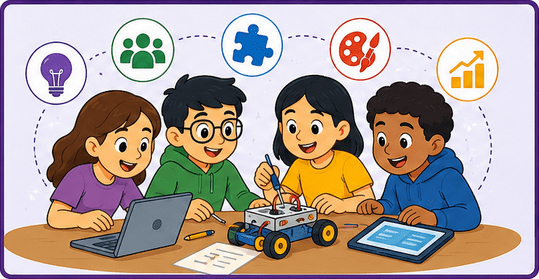
What if your child could learn in a way that feels less like studying and more like exploring?
Think about how kids naturally behave: they ask questions, take things apart, try again when something breaks, and come up with ideas that often surprise us. That curiosity is powerful, but traditional learning often fails to fully utilize it.
If you’ve been exploring schools, the blogs, Facebook parent groups, or education websites lately, you’ve probably seen the word STEM pop up everywhere. It’s one of the fastest-growing learning approaches in the USA, and for good reason. It sounds exciting, maybe even a little intimidating.
But what does STEM education mean for your child? And why are so many parents in the USA enrolling their kids in STEM classes?
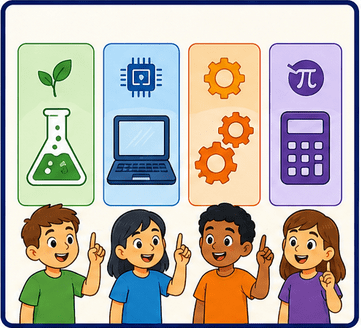
STEM stands for:
| Letter | Stands for | What kids learn. |
| S | Science | Asking questions, testing ideas, understanding the world |
| T | Technology | Using digital tools, coding, problem solving with tech |
| E | Engineering | Building designing, and fixing things |
| M | Mathematics | Number, patterns, logical reasoning |
These five areas are taught together. When a child builds a bridge out of popsicle sticks, they’re using engineering, math, and creative thinking all at the same time.
You might have heard of STEM. STEAM is just STEM with one important addition: The Arts.
STEM : Science, Technology, Engineering, Mathematics
STEAM: Science, Technology, Engineering, Arts, Mathematics
When does that letter matter so much? Because creativity is the ingredient that turns a good scientist into a great innovator. Addition arts and design thinking help kids:
Many people in the USA believe that art makes STEAM more effective, especially for kids who might feel left out by traditional STEM programs. But the challenging thing is art is difficult to learn online.
Want your child to develop these skills? Join our STEM program to strengthen the math and logic foundation.
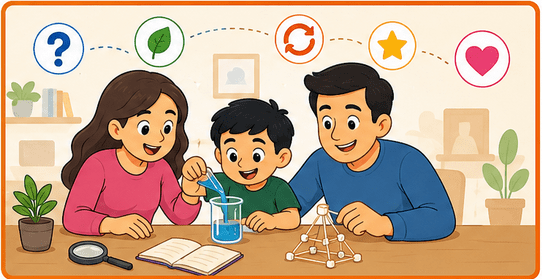
The world your child will grow up in looks very different from the one you went to school in. As per the rapid development most of the jobs may vanish in 10 to 15 years and we will have new ones that haven’t been invented yet. And the skills that will matter most are:
STEAM isn’t just about sitting in a classroom. It’s hands-on, project-based learning for kids that feels more like play than work.
Here are a few examples of STEAM activities your child might do:
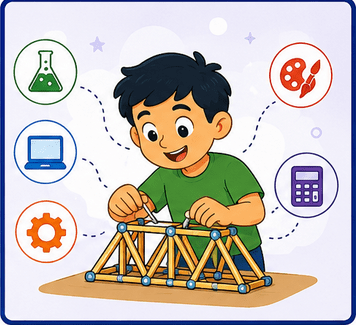
One of the biggest shifts STEM brings is how children approach challenges. Instead of looking for quick answers, kids start focusing on the process, understanding the problems, testing different ideas, and improving step by step. This builds patience and deeper thinking. Over time, children stop asking “Is this right?” and start asking “How can I make this better?” That is something powerful because it shows they are exploring more than just learning, helping kids become more independent and confident in their decisions.
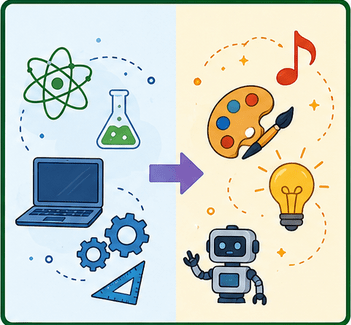
You don’t need fancy equipment or a special school to introduce STEAM to your child. Here’s a simple roadmap:
Ask:
Let kids:
There are many beginner-friendly coding platforms and DIY project ideas available.
A strong base in math helps children succeed in all STEAM areas.
Let kids:
STEAM works best when learning feels safe and fun.
Many kids don’t struggle with steam; they struggle with foundations.
The 3 hidden gaps are
1. Weak math base
If there is no maths involved, here are the things that a problem
2. Low Confidence
Kids hesitate to try because they fear being wrong.
3. Over instructions
They are used to being instructed and controlled for what to do.

STEM education is not about adding extra pressure or turning your child into a scientist overnight. It’s about helping them think better, solve smarter, and stay curious in a world that’s constantly changing.
When children learn through STEM, they don’t just memorize answers; they learn how to approach problems, test ideas, and adapt when things don’t go as planned. And that’s a skill set that goes far beyond the classroom.
But here’s what truly makes the difference.
A strong foundation in major subjects like Maths and Technology is most important for the modern world. So, enrol them today for the Jainam STEM classes. Because no matter how hard you try at home, proper guidance from the profession can change your kid’s future.
No. STEM actually helps all types of learners by making education more interactive.
No. It complements school learning by making concepts practical.
Not always. Many activities are hands-on and require simple materials.
As early as possible, curiosity based learning starts in early childhood.
It teaches kids how to think, not just what to learn.